
Wound Assessment and Management
Defines how wounds are assessed, bleeding is controlled, dressings are selected and escalation decisions are made in the field.
Purpose
This procedure defines how wounds are assessed and managed in the field.
It ensures that bleeding is controlled appropriately, wounds are treated according to severity and that patients are escalated where required.
Scope
This procedure applies to all clinicians managing wounds during operational deployments.
It covers all wound types including minor wounds, lacerations, burns and catastrophic haemorrhage.
Operational Principle
Bleeding Control Comes First
The priority in wound management is control of bleeding.
The clinician must first identify and manage life-threatening haemorrhage before proceeding to wound care.
All wounds must be assessed systematically and treated according to severity.
Initial Wound Assessment
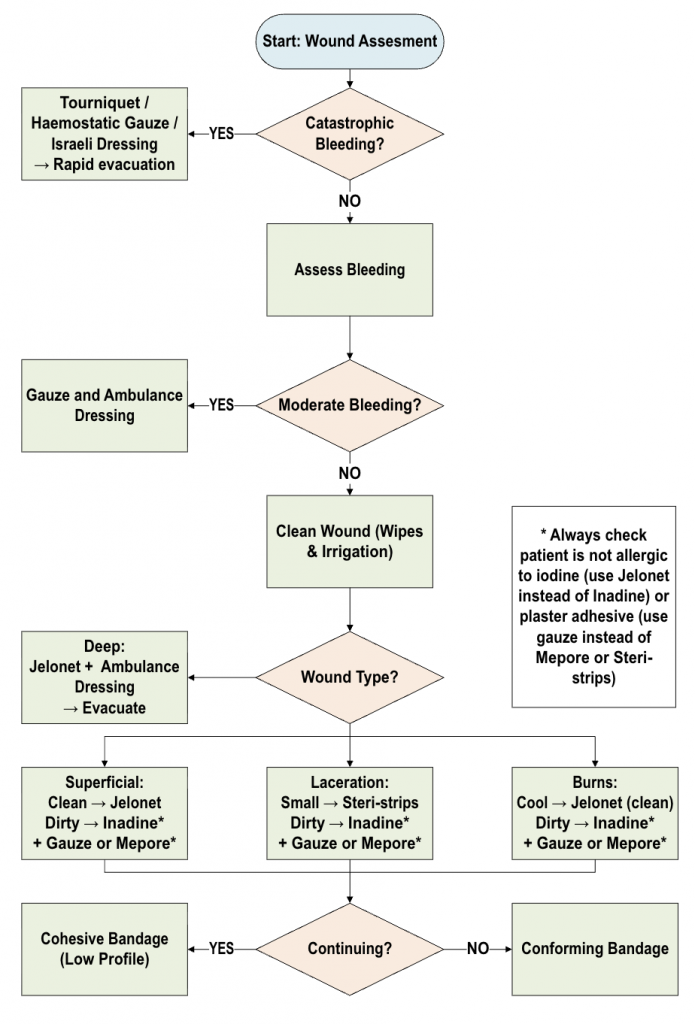
The clinician must begin with an immediate assessment of bleeding.
If catastrophic haemorrhage is present, the clinician must not delay and must initiate haemorrhage control immediately.
If catastrophic haemorrhage is not present, the clinician must assess the level of bleeding and proceed accordingly.
Management of Catastrophic Haemorrhage
If catastrophic bleeding is identified, the clinician must immediately apply a tourniquet where appropriate.
If a tourniquet is not suitable, haemostatic gauze must be applied with direct pressure.
An emergency bandage or equivalent pressure dressing must be used to secure haemostasis.
The clinician must initiate urgent evacuation without delay.
Assessment of Non-Catastrophic Bleeding
Where bleeding is not catastrophic, the clinician must determine whether it is moderate or minor.
Moderate Bleeding
Bleeding that requires sustained pressure or dressing to control.
Minor Bleeding
Bleeding that is easily controlled.
Management of Moderate Bleeding
Where moderate bleeding is present, the clinician must apply direct pressure using sterile gauze.
An ambulance dressing or equivalent pressure dressing must be applied to control bleeding.
The wound must be stabilised and the patient must be assessed for escalation or evacuation.
Cleaning of Wounds
Once bleeding is controlled and not life-threatening, the clinician must clean the wound.
Cleaning must be performed using non-alcoholic wipes and irrigation using saline pods from the medication pouch where required.
The clinician must remove debris and reduce contamination prior to dressing using disposable tweezers from the dressings pouch.
Wound Type Assessment
Following cleaning, the clinician must assess the type and depth of the wound.
The clinician must determine whether the wound is superficial, deep, a laceration or a burn.
This classification determines treatment and escalation.
Management of Deep Wounds
Where a wound is deep, the clinician must apply a non-adherent dressing.
Jelonet must be used as the primary dressing layer.
An ambulance dressing must then be applied to secure the wound.
The clinician must arrange evacuation for further medical assessment.
Management of Superficial Wounds
Where a wound is superficial, the clinician must clean the wound thoroughly.
A non-adherent dressing must be applied.
Jelonet should be used for clean wounds.
If the wound is contaminated, Inadine should be used where appropriate.
A secondary dressing such as gauze or Mepore must be applied to provide an absorbent layer.
Management of Lacerations
For small lacerations, the clinician may approximate the wound using steri-strips where appropriate.
If steri-strips are used, patients must be referred to UTC/MIU for further assessment to reduce the risk of infection.
The wound must be clean prior to closure.
If the wound is contaminated, Inadine should be used before applying a secondary dressing.
If steri-strips are not appropriate, the wound must be dressed and referred for further care.
Management of Burns
Burns must be cooled immediately using running clean water for 20 minutes where available.
Following cooling, the clinician must assess whether the burn is clean or contaminated.
Clean burns must be dressed using a non-adherent dressing such as Jelonet.
Contaminated burns may be managed using Inadine where appropriate.
A secondary dressing such as gauze or Mepore must be applied.
Allergy Considerations
The clinician must always check for allergies before selecting dressings.
- If the patient has an iodine allergy, Inadine must not be used and Jelonet must be used instead.
- If the patient has an adhesive allergy, adhesive dressings must be avoided and gauze with bandaging must be used instead of Mepore or steri-strips.
Failure to check for allergies must be treated as a clinical error.
Dressing Securing Method
Once the wound is dressed, the clinician must secure the dressing appropriately.
If the dressing is stable and low profile is appropriate, a cohesive bandage may be used.
If additional support is required, a conforming bandage must be applied.
The clinician must ensure that circulation is not compromised.
Ongoing Bleeding Assessment
Following dressing, the clinician must assess whether bleeding continues.
If bleeding continues, the dressing must be reinforced and further pressure applied.
If bleeding is controlled, the dressing must be left undisturbed.
Escalation and Referral
The clinician must escalate where required.
Deep wounds, uncontrolled bleeding, wounds requiring suturing or any concern regarding infection or structural damage must be referred.
The clinician must arrange evacuation or advise onward care as appropriate.
Return to Activity
The clinician may allow return to activity where the wound is minor, bleeding is controlled and the dressing is secure.
The clinician must ensure that the patient understands the risks and must provide appropriate advice.
If there is any doubt, the patient must be withdrawn.
Documentation
All wounds must be documented in the PRF.
The clinician must record wound type, location, depth, treatment provided, dressings used and any escalation or advice given.
Allergy status must be recorded.
Operational Standard
Bleeding Must Be Controlled and Wounds Managed by Severity
At all times, it must be possible to demonstrate that bleeding is controlled appropriately, that wounds are treated according to severity and that escalation occurs where required.
If bleeding control is delayed or wounds are inappropriately managed, the system is not safe.
Review of This Procedure
This procedure must be reviewed annually or sooner if clinical guidance or operational experience requires amendment.
Review Date: 24 March 2026